
How Thermal Barriers Help Limit Heat Propagation in EV Batteries
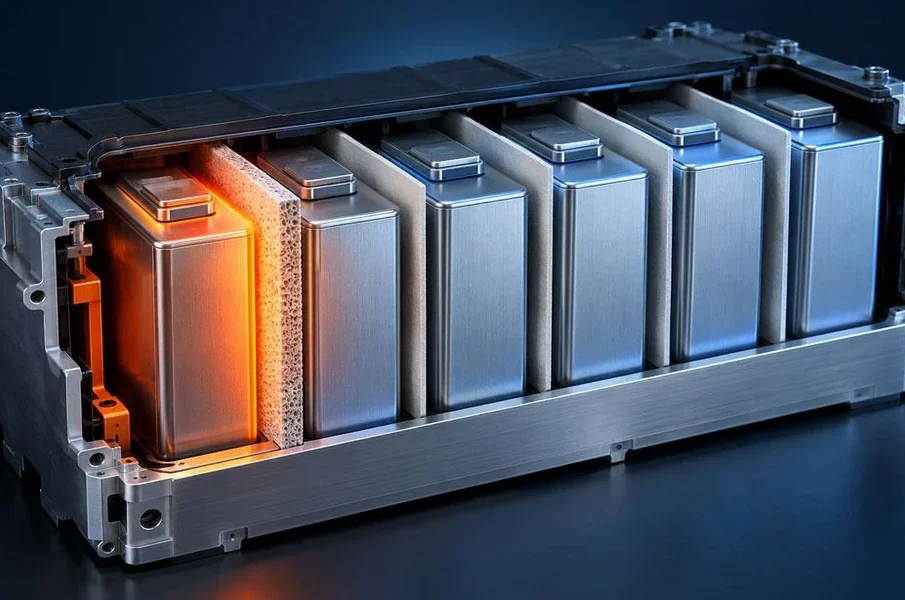
An electric vehicle battery is designed to operate as a coordinated system. Cells deliver power, cooling systems remove heat, and electronics monitor operating conditions. Yet battery protection also depends on something much less visible: the materials separating one component from another.
Those materials become particularly important when a cell experiences thermal runaway, a self-accelerating event that can release intense heat and gas. A central engineering question is whether the effects of that failure can spread to neighboring cells. Thermal barriers help address this question by resisting heat transfer along specific paths within the battery assembly.
Understanding their role requires looking beyond the highest temperature printed on a material datasheet.
Cooling and thermal barriers serve different purposes
During normal driving and charging, a battery needs to transfer heat toward its cooling system. Thermal interface materials can help heat move from cells or modules to a cooling plate.
A protective barrier has a different job. At selected locations, it is intended to slow heat reaching components that should remain protected during an abnormal event. Good battery design therefore needs both controlled heat removal and carefully positioned thermal resistance.
Covering every surface with insulation would overlook that distinction. A useful starting point is to map where heat should travel during ordinary operation, then identify the paths that could expose neighboring cells during a failure.
Placement matters as much as material selection
A barrier between two cell faces addresses one heat-transfer path. It does not automatically address heat traveling through a shared metal structure or around an exposed edge. Hot vented gases introduce another challenge, particularly if they reach components outside the protected area.
For this reason, barrier selection should begin with the battery architecture. Engineers need to consider cell orientation, spacing, attachment points, vent routing, and the relationship between a barrier and the surrounding enclosure. A material with promising laboratory properties can still be poorly matched to its installed location.
Thickness is another practical consideration. Increasing thickness may improve thermal resistance, but it also occupies space. The useful question is how much protection a specific construction provides within the available package, including the effects of compression and assembly tolerances.
Different protection locations call for different materials
Between-cell protection often calls for a thin material that can resist heat transfer without consuming excessive space. Nano-silica composite thermal insulation board is a thermal protection material for cells in power and energy storage batteries, designed to limit heat transfer and thermal propagation.
Other locations may combine thermal protection with a need for sealing or cushioning. Ceramifiable silicone foam is positioned for new energy vehicle battery pack applications involving sealing, shock absorption, thermal protection, and electrical insulation. These functions make it a different material candidate rather than a direct substitute for every rigid barrier.
The distinction is useful when preparing a material shortlist: first define the role and location, then compare candidates against that requirement.
Evaluate the assembly, not just the sample
Datasheets help narrow the search, but assembled battery behavior requires a broader evaluation. A thermal conductivity measurement describes performance under specified conditions. It does not, by itself, describe how a complete module responds to a failing cell.
Likewise, a small-scale flammability classification is not a demonstration that a battery pack will contain thermal runaway. UL Solutions explains that UL 94 evaluates material flammability under controlled laboratory conditions.
A practical development program should therefore examine the selected material in its intended construction, including joints, cutouts, compression, and attachment methods. This connects material properties to the actual heat paths the design must manage.
Thermal barriers are one part of a coordinated protection strategy. Their value comes from matching the material to the location and confirming that the finished assembly performs as intended.