
The Buzz Killer: Why Race Cars Use Flax Fiber Where Carbon Would Buzz
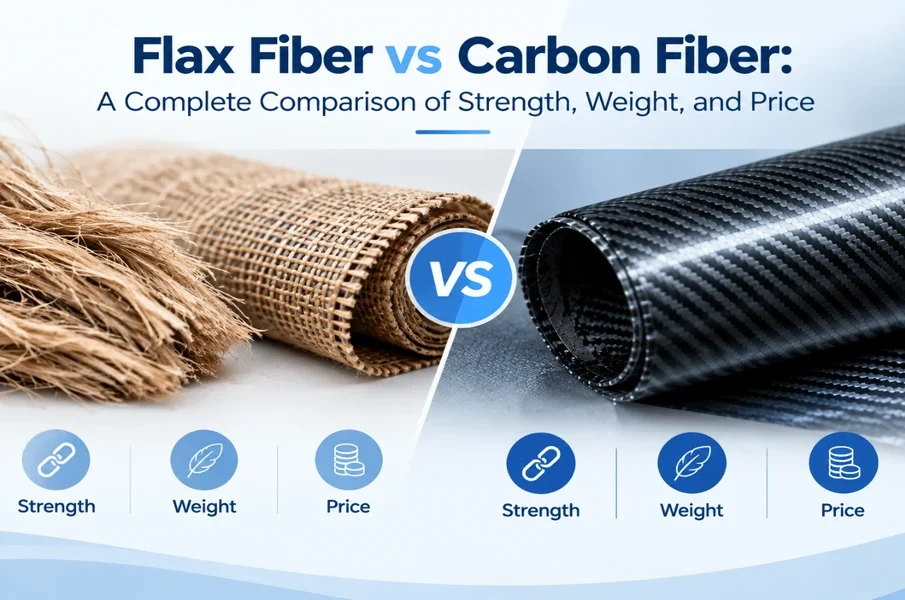
The quietest material in motorsport grew in a field.
Ask an engineer what carbon fiber does badly and you get a short, honest list. And near the top sits a property most buyers never think about: vibration damping. Carbon is stiff, light, and rings like a bell. For a guitar that would be a feature. For a car interior panel at 7,000 RPM, it is a problem. The solution arriving from motorsport is unexpected: a plant.
Stiffness Has a Shadow
Every material has a relationship with vibration. Steel thuds. Aluminum rings. Carbon fiber, for all its virtues, transmits vibration eagerly. High stiffness and low internal damping mean the panel passes along whatever the road and engine send it. On a race car, that contributes to driver fatigue over a stint. On a road car, it is the difference between a cabin that feels solid and one that feels like the inside of a drum. Engineers call this NVH, noise, vibration, harshness, and it is the invisible line between premium and punishing.
What Flax Does to Vibration
Flax fibers have a completely different internal structure. Natural cellulose microfibrils arranged in a way that dissipates vibrational energy instead of conducting it. Measured damping improvements of up to five times over carbon fiber are cited in the literature, and you do not need instruments to perceive it: flax panels simply feel deader, quieter, more solid. The flax vs carbon fiber comparison covers the full property picture, but damping is where flax does not just compete with carbon, it embarrasses it.
Damping Is Not Sound Deadening
A distinction worth keeping straight: damping is a structural property, how the panel itself handles vibration, while sound deadening is usually an added layer, heavy mats glued to panels to swallow noise after the fact. Deadening works, but it adds exactly the weight that composite parts exist to remove. A panel that damps vibration by its own nature needs little or no added deadening, which is why flax’s NVH advantage is really a weight advantage in disguise. The quietest way to build light is to build with materials that are quiet.
Where This Actually Matters
Door panels, dashboards, center consoles, seat shells, headliners. The parts that surround the occupants and face the cabin’s acoustics. These are the pieces that translate road texture into cabin noise, and they are exactly where flax has been winning professional applications. Motorsport figured this out first: racing seat shells in flax protect drivers from hours of buzz, and series-backed flax bodywork programs proved the material survives professional abuse. When Porsche and McLaren put a material in their programs, the NVH data has already won the argument.
The Physics, Briefly
Why does flax damp so well? Cellulose microfibrils inside the fiber can slip microscopically against each other under vibration, converting motion into tiny amounts of heat. Carbon’s crystalline structure has no such give. It is a lattice, and lattices ring. Same reason a wooden ruler and a carbon tube sound different when tapped: one swallows the energy, the other sings it back. Nature spent millennia evolving fibers that flex without failing. Engineers are simply reading her notes.
The Other Wheels Already Know
The two-wheeled world arrived at the same conclusion independently. High-end bicycle makers have experimented with flax layups for exactly the damping reason. Long days on rough roads punish riders through the frame, and a material that eats vibration at zero weight penalty is worth real money when the engine is a pair of human legs. Motorcycle bodywork and luggage have followed. Cyclists describe flax frames the way drivers describe well-damped cars: planted, calm, quiet. The vocabulary of comfort turns out to be universal.
What It Means for a Road Car Build
For the street or track enthusiast, the lesson is practical: material choice is not only about stiffness and weight. An interior built entirely in carbon looks like a race car and, in the wrong hands, sounds like one too. Buzzing trim, resonating panels, the slow fatigue of a cabin that never stops talking. Interior pieces and seat shells in flax or hybrid layups keep the lightweight, technical aesthetic while swallowing the buzz. For the exterior structure, carbon remains untouchable. The carbon fiber material guide shows why its stiffness is irreplaceable where loads are real.
The Hybrid Future
The smartest builds will not choose. Flax-carbon hybrid laminates already exist, layering carbon where stiffness is needed and flax where damping is wanted, tuning the panel’s acoustic behavior like an instrument. Structure from the carbon, silence from the flax, weight savings from both. That is not compromise. That is engineering with a bigger toolbox.
Carbon fiber made cars light and stiff, and everyone noticed. Flax is making them light and quiet, and nobody notices. Which is, of course, the entire point of damping. The best NVH work is the kind you never hear.