The Badge on the Car Does Not Identify the Wheel Being Repaired
Before applying a manufacturer’s wheel-repair guidance, establish which wheel is actually in front of the repairer and which documentation covers it. A car’s badge does not prove that every set fitted during its life came from the vehicle maker. Two seasonal sets can have different origins. The distinction matters when technical guidance restricts work on particular manufacturer-supplied wheels.
Imagine buying a used Tesla with a summer set already fitted and a second set stored for winter. The seller describes one as original and says the other “fits the car.” Later, one wheel needs attention. You have useful clues, but not yet a verified account of both sets. The task is to resolve their identities before translating a general service offer or a technical restriction into a decision.
Two sets on one car can have different origins
The history of a vehicle and the history of a removable component are related without being identical. A seasonal set may have been bought later, transferred from another owner or supplied with incomplete paperwork. Even a set that has accompanied the car for years should not be described as factory-supplied solely because nobody remembers purchasing it. Preserve the difference between what is known and what was assumed.
Keep the two sets distinguishable during the enquiry. Identify which wheel is being discussed and which set it belongs to, using photographs, receipts and existing records where available. Mark that distinction in filenames when sending pictures of both sets together. A photograph of the car wearing its summer wheels is a poor reference for a loose winter wheel being examined elsewhere. That simple mix-up can send the conversation toward the wrong component before anyone considers a repair method.
An invoice from the later purchase may help identify a manufacturer or product, but an incomplete receipt should remain incomplete evidence. “Winter package” does not necessarily establish the wheel’s origin. Ask the supplying business or an appropriate professional to interpret the available information. Do not fill gaps with a familiar-looking logo, a seller’s confident recollection or a product image found through a visual search.
The uncertainty does not mean the later set is unsuitable or that the original set is automatically serviceable. It means each needs to be identified and assessed on its own terms. Avoid treating provenance as a verdict about condition. Knowing who supplied a wheel helps locate the appropriate guidance; it does not replace the examination or other requirements that apply to that actual component.
Read the scope of the document before its repair list
A concrete example appears in Tesla’s 2017-2023 Model 3 collision-repair documentation. Its Approved Wheel Repairs page describes restrictions for Tesla-provided wheels, including prohibitions on welding, crack repair, straightening, bending, machining and chrome plating. Those are manufacturer restrictions, not procedures for an owner to attempt or instructions to substitute another repair method.
The scope is part of the information. A reader should not turn that page into a universal statement about every wheel on every Tesla, or about all other makes. Equally, an unidentified later set is not automatically exempt or repairable because its origin is unclear. The appropriate professional needs to establish the relevant component and applicable manufacturer information before recommending work.
Read the page in its manual context rather than saving only a cropped list. The model range, document title and component description help explain what the instruction concerns. A screenshot circulated without that context can acquire a broader meaning than its source supports. When discussing a restriction, share the actual source so the adviser can evaluate its applicability instead of relying on a paraphrase.
The two-set scenario makes that discipline practical. If the damaged wheel belongs to the identified original set, the enquiry can use the appropriate OEM information. If it belongs to a later set, the enquiry begins by establishing that set’s identity and relevant guidance. Neither route should rely on the fact that both sets have been installed on the same car.
A familiar design is an identification clue
Owners often recognise a wheel by its spoke pattern, colour or centre cap. Those observations can help communicate which item they mean. They should not be asked to carry more certainty than they provide. Ask the assessor how it will identify the wheel and what information it needs, particularly when the component was acquired second-hand and records are limited.
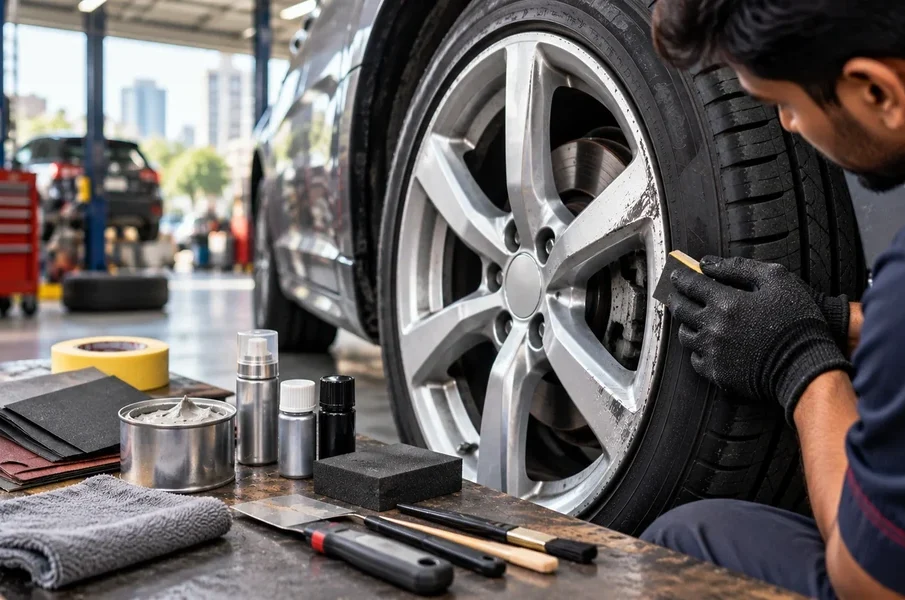
If you ask Onyx Rims about wheel repair in Toronto, describe the two sets separately. Explain which is believed to be original, what supports that description and which remains uncertain. Supply existing photographs or records through the business’s normal enquiry route. This gives the repairer a component question to resolve before the owner asks for a particular process.
Do not remove the wheel or disturb hardware simply to collect hidden identification. If relevant details are not safely visible, let the appropriate professional explain how identification will be handled. Where damage is suspected, obtain guidance on handling and transport as well. A more complete product description is valuable, but obtaining it should not become a reason for unsafe inspection or continued use.
A general statement that a shop offers wheel repair does not establish that it is authorised by the vehicle manufacturer or that every method is appropriate for the wheel. Keep those claims out of the conversation unless they can be supported. The owner needs an explanation connected to the identified component, applicable documentation and assessment, rather than confidence borrowed from a broad service name.
Resolve the unknown wheel rather than guessing the rule
The most useful outcome may be two separate, modest descriptions: an identified original seasonal set with its relevant manufacturer information, and an identified later set with its own documentation. They can be stored with the corresponding records so the next service enquiry starts from the actual components. There is no benefit in compressing both into “the Tesla wheels” if that phrase conceals the distinction.
If the later set cannot yet be identified, leave that question open for professional resolution. Do not apply the original set’s identity to it for convenience, and do not treat the missing identity as permission to proceed. Keep the two sets separate in the records and in the discussion. The car can wear both at different times; the technical decision still belongs to the particular wheel.